Update
Virtual spatial transcriptomics goes global
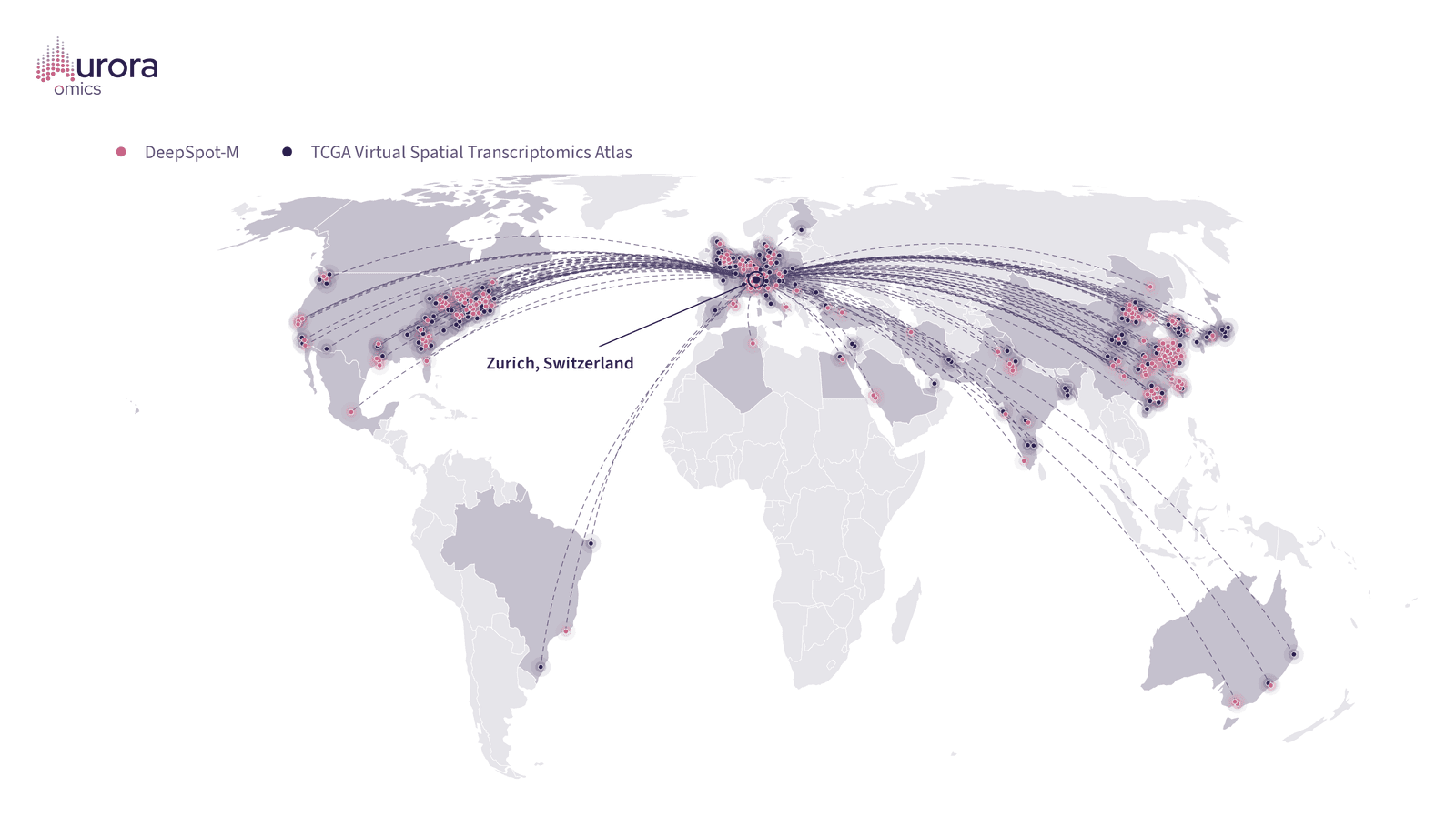
Researchers on every inhabited continent now have access to DeepSpot-M and the TCGA Virtual Spatial Transcriptomics Atlas, and interest keeps growing. To us, it is an early sign of where the field is heading.
With the H&E slides they already have, researchers can explore spatial gene expression across more of their cohort and decide which samples or regions to profile next.
Spatial transcriptomics shows where genes are active inside tissue, and it has changed how researchers study cancer, development and disease. Measuring it is still costly, and access remains concentrated. Routine histology, by contrast, sits in every pathology department, every biobank and every archive of past studies.
Predicting spatial gene expression from those slides opens questions that were out of reach.
Archives, with the tissue kept
Analyse retrospective archives while the blocks and biopsies themselves stay preserved.
Larger, outcome-linked cohorts
Stratify patients across cohorts large enough to link spatial patterns to outcome.
The biology behind the morphology
Uncover the molecular programmes behind the tissue patterns you observe.
The next experiment
Choose which samples or regions to profile next, guided by predicted maps.
Virtual spatial transcriptomics makes this possible by predicting the spatial expression of 19,338 protein-coding genes from histology images. Aurora uses our DeepSpot-M model (preprint), and we took 1st place in the Autoimmune Disease Machine Learning Challenge organised by the Broad Institute of MIT and Harvard.
Seeing researchers in so many places take up these tools makes us optimistic. Each new group brings new tissues, new questions and new ways to test what the predictions show, and that is how the field moves forward.
We are keen to support impactful academic research. If you would like to explore how we can support your work further, get in touch. Please also share this post with colleagues whose research could benefit.
For research use only. Aurora is not a medical device. Terms apply.