Help shape the next era of spatial discovery.
Bring computational exploration alongside your experimental expertise. Help research teams see new possibilities in their tissue and carry ambitious ideas further.
Aurora predicts spatial gene expression from the H&E slides researchers already bring, before a run and after it, so your facility's expertise reaches further into each project.
Applications
Expertise that reaches before the run and after it
- ExploreBefore a project
A first look before anything is booked
Offer virtual spatial analysis on a group's existing H&E slides, and a pilot question gets its first look on predicted expression.
- Run a computational pilot on slides the group already has
- Book the next run for the hypothesis that holds up
- Join the science before the first section is cut
- Look aheadBefore capture
A capture area placed with the whole section in view
Predicted expression across the whole section shows where the signal varies, before the capture area is fixed.
- Find where the predicted signal varies most
- Place the capture area across a boundary of interest
- Show the researcher what the square will leave out
Built onOut-of-the-box prediction
DeepSpot-M predicts 19,338 protein-coding genes at every retained tile of a slide, from the H&E image alone.[1]
- ExtendAfter the experiment
A finished run that can answer more
With our team, a finished run goes back to its group with predicted genes beyond the panel, adapted to the measured data, and the genes that failed quality control restored.
Its measured genes stay as they were, and every added one is marked as a prediction.
- Show a group what lies beyond its panel, on the spots its run measured
- Offer restored genes, marked as predictions, where a run lost them in quality control
- Hand the group a second round of hypotheses from the same tissue
Built onPanel extensionFinetuneRestore genes
Arranged with our team, on the Academic Research Pro route.See Academic Research Pro
The DeepSpot-M preprint demonstrates prediction for genes excluded from training.[1]
Your route
A partnership, or one group at a time
Core facilities and service labs running spatial assays for other groups.
Offering virtual spatial analysis to your own customers is a partnership, so it starts with a conversation. Submitting a slide for one group is simpler: the eligibility rule follows the research and not the facility, so it is the requesting group that must be academic or non-profit.
Worked examples
Around the run, on real tissue
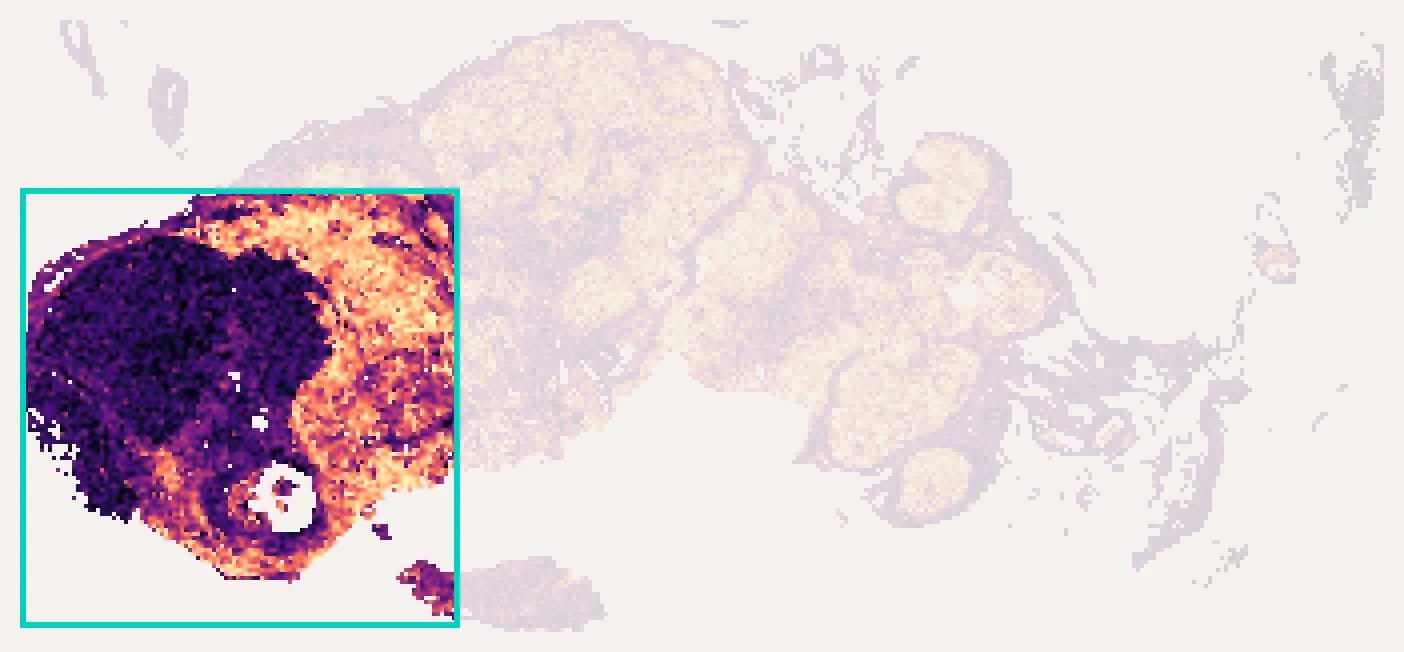
Begin your next experiment with a wider view.
Rank the candidate samples on predicted expression, and choose where each capture area goes.
- You bring
- The slides you are choosing between.
Let discovery move beyond the original question.
Predict the genes your panel left out, on the spots it measured, then choose which leads to validate.
Arranged with our team
- You bring
- An H&E image and the panel you measured, with a position per spot.
Bring AI closer to the biology you study.
Adapt the model to your protocol from a few measured slides, or restore genes that failed quality control as labelled predictions.
Arranged with our team
- You bring
- A few slides you have measured, each with its image.
References
- [1]Nonchev K, Dawo S, Silina K, Koelzer VH, Rätsch G. DeepSpot-M: a multimodal foundation model for transcriptome-wide virtual spatial transcriptomics from histology. medRxiv. Preprint, 2026. https://doi.org/10.64898/2026.06.19.26356060 (opens in a new tab)