Ask the question your last study could not.
Research rarely ends with the question it started with. Aurora opens a new way to explore the tissue you already know—and follow the ideas that emerge from it.
With predicted spatial gene expression from H&E slides, the study you finished can take up the question it could not ask.
Applications
Questions that outlive the study that raised them
- Explore
The idea that arrived after the study ended
A study's H&E slides already cover every case, and most of that tissue never reaches a measured experiment.
Predicted expression on those slides lets a new idea run through the whole collection, including cases whose blocks are long gone.
- Revisit a published cohort with a new molecular question
- Compare samples that were never profiled, on the same genes
- Set the old cohort beside your new one, gene for gene
Built onOut-of-the-box predictionComparative spatial analysis
DeepSpot-M predicts 19,338 protein-coding genes at every retained tile of a slide, from the H&E image alone.[1]
- Explore
The observation that stayed with you
A pattern you noticed in a section, and could only describe, can be put to the genes behind it on predicted expression.
Which genes vary most across the section?
Spatially variable genes, ranked by Moran's I, in the spatial analysis report
Which regions carry different expression programmes?
Clusters drawn on the tissue, with their marker genes, in the spatial analysis report
Which clusters sit next to each other in the tissue?
Neighbourhood enrichment between clusters, in the spatial analysis report
How does one gene look on the tissue, and on the UMAP?
Any predicted gene, on the tissue and on the UMAP, in the explorer, on the Academic Research route
What separates one region from another?
Differential expression between two groups you select, in the explorer, on the Academic Research route
- Extend
The result that pointed past the panel
With our team, the panel you measured anchors predictions for the protein-coding genes it never carried, and the genes that failed quality control are restored.
Each predicted gene lands on the spots your assay reported, marked as a prediction beside the measured columns.
- Follow the gene your result pointed at, past the panel
- Recover the genes your run lost, without cutting the section again
- Adapt predictions to the slides you measured
Built onPanel extensionRestore genesFinetune
Arranged with our team, on the Academic Research Pro route.See Academic Research Pro
The DeepSpot-M preprint demonstrates prediction for genes excluded from training.[1]
- Look ahead
The question left open for the next study
Explore a hypothesis on predicted expression across the slides a study already holds, and the next experiment can begin where the pattern is.
- Check whether a spatial pattern appears before you plan to measure it
- Choose the samples and regions a proposal will measure
- Set aside a question the predicted data does not support
Your route
Start with the slides you already have
If the analysis raises a hypothesis, use measured spatial profiling to test it.
University groups, institutes, hospitals and foundations working on their own cohorts.
Submit an H&E slide and read predicted spatial gene expression back, with no assay to book and no agreement to sign. Analysis is for academic and non-profit research. If your work sits between academic and commercial, ask before you prepare a slide.
Worked examples
Followed through on real tissue
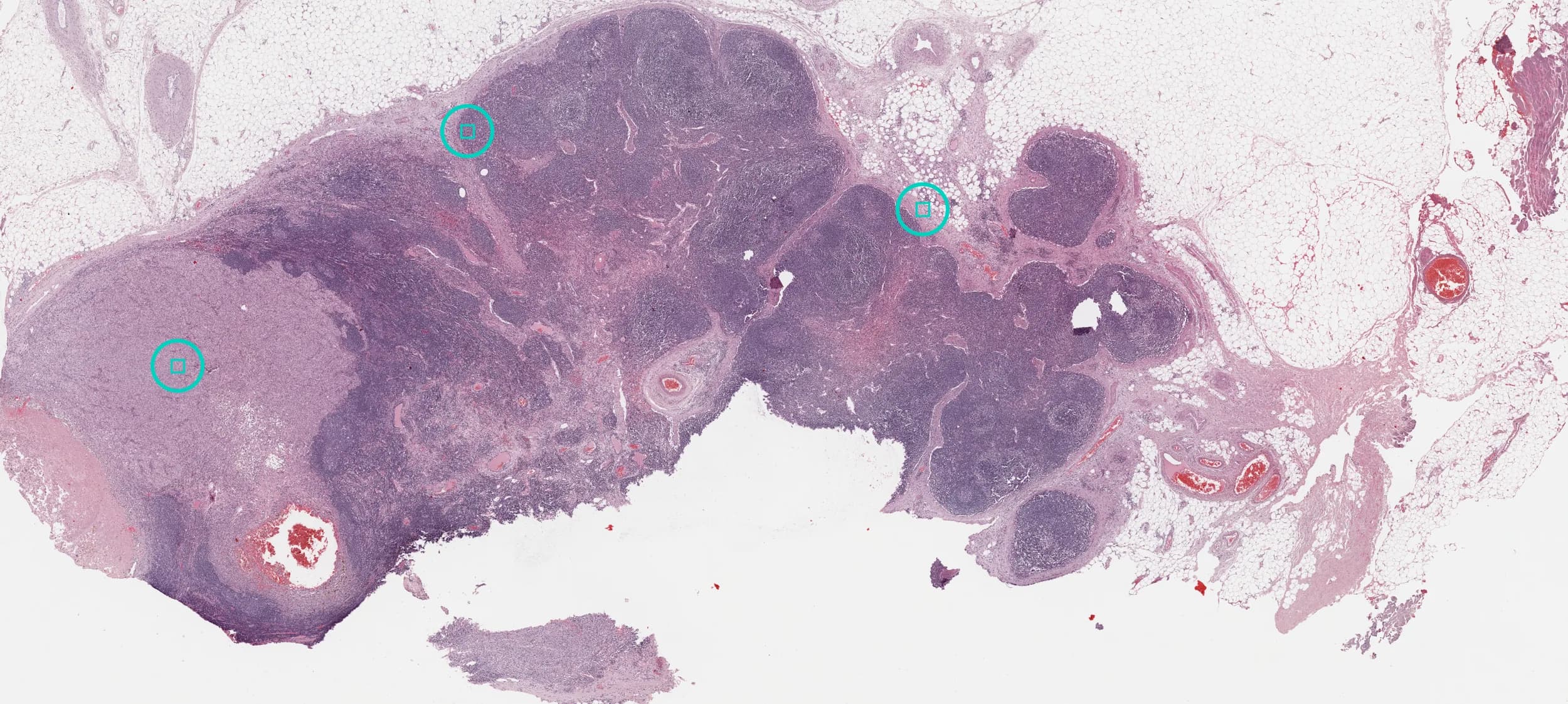
A new chapter for your collection.
Explore the whole archive on the same predicted genes, and keep measured follow-up for the hypotheses that survive.
- You bring
- One H&E slide per sample. Nothing else.
Let discovery move beyond the original question.
Predict the genes your panel left out, on the spots it measured, then choose which leads to validate.
Arranged with our team
- You bring
- An H&E image and the panel you measured, with a position per spot.
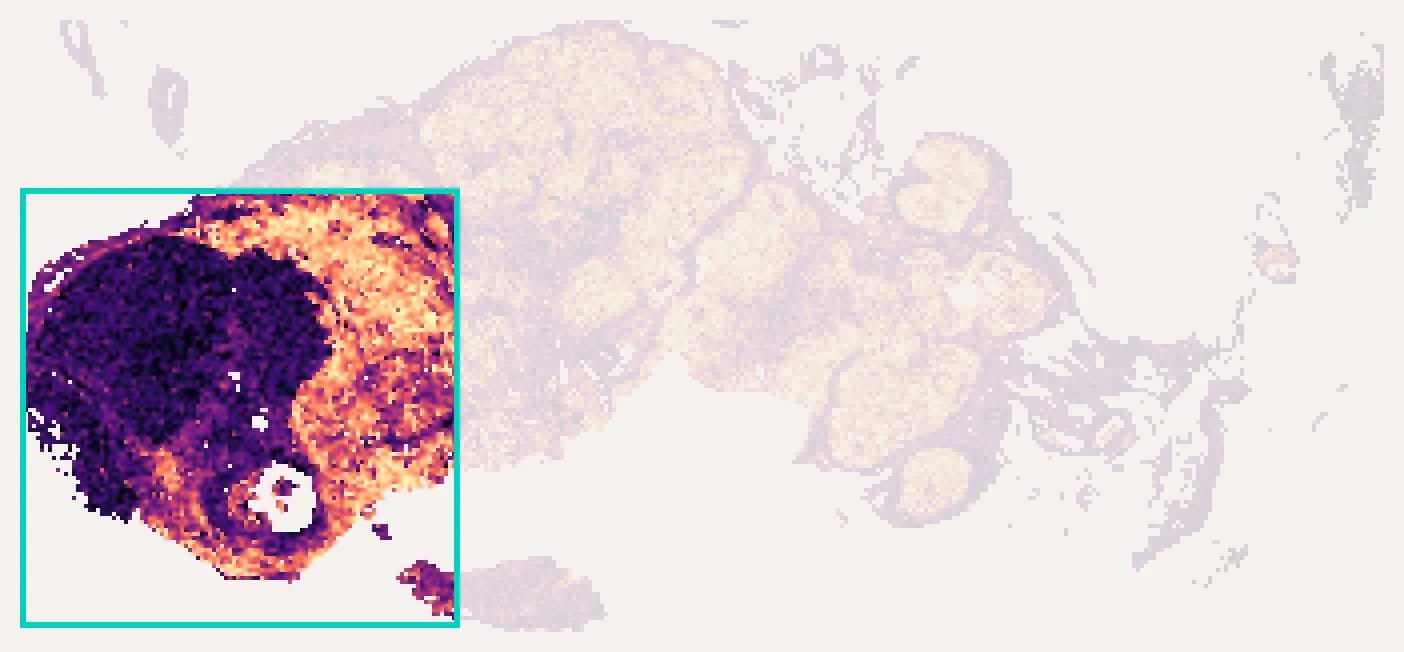
Begin your next experiment with a wider view.
Rank the candidate samples on predicted expression, and choose where each capture area goes.
- You bring
- The slides you are choosing between.
References
- [1]Nonchev K, Dawo S, Silina K, Koelzer VH, Rätsch G. DeepSpot-M: a multimodal foundation model for transcriptome-wide virtual spatial transcriptomics from histology. medRxiv. Preprint, 2026. https://doi.org/10.64898/2026.06.19.26356060 (opens in a new tab)